The problem
Friends who live far apart can dance together on a video call or in VR. But the friend stays inside a screen. You never feel them in your own room.
 Published paper at ACM TEI 2024
Cork, Ireland, February 2024 doi.org/10.1145/3623509.3633385
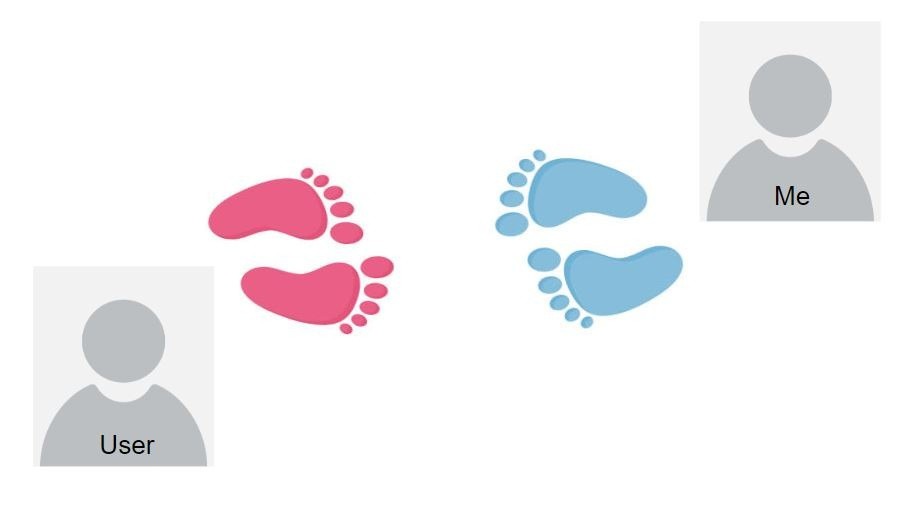
Two friends dance in two different rooms. Each one sees the other’s footsteps move across their own floor, in real time.
Peer-reviewed and presented at the Eighteenth International Conference on Tangible, Embedded, and Embodied Interaction.

First author. I led the research, the concept, the prototypes and the user tests.
User survey, concept design, two prototypes, user testing, published paper.
Gargi Guchhait with Atsuro Ueki and Masa Inakage, Keio University Graduate School of Media Design.
First survey in May 2022. Paper presented in February 2024.
Friends who live far apart can dance together on a video call or in VR. But the friend stays inside a screen. You never feel them in your own room.
I put the friend on the floor. A sensor reads their feet and a projector draws their footsteps on your floor as they move. We call it sharing the same ground.
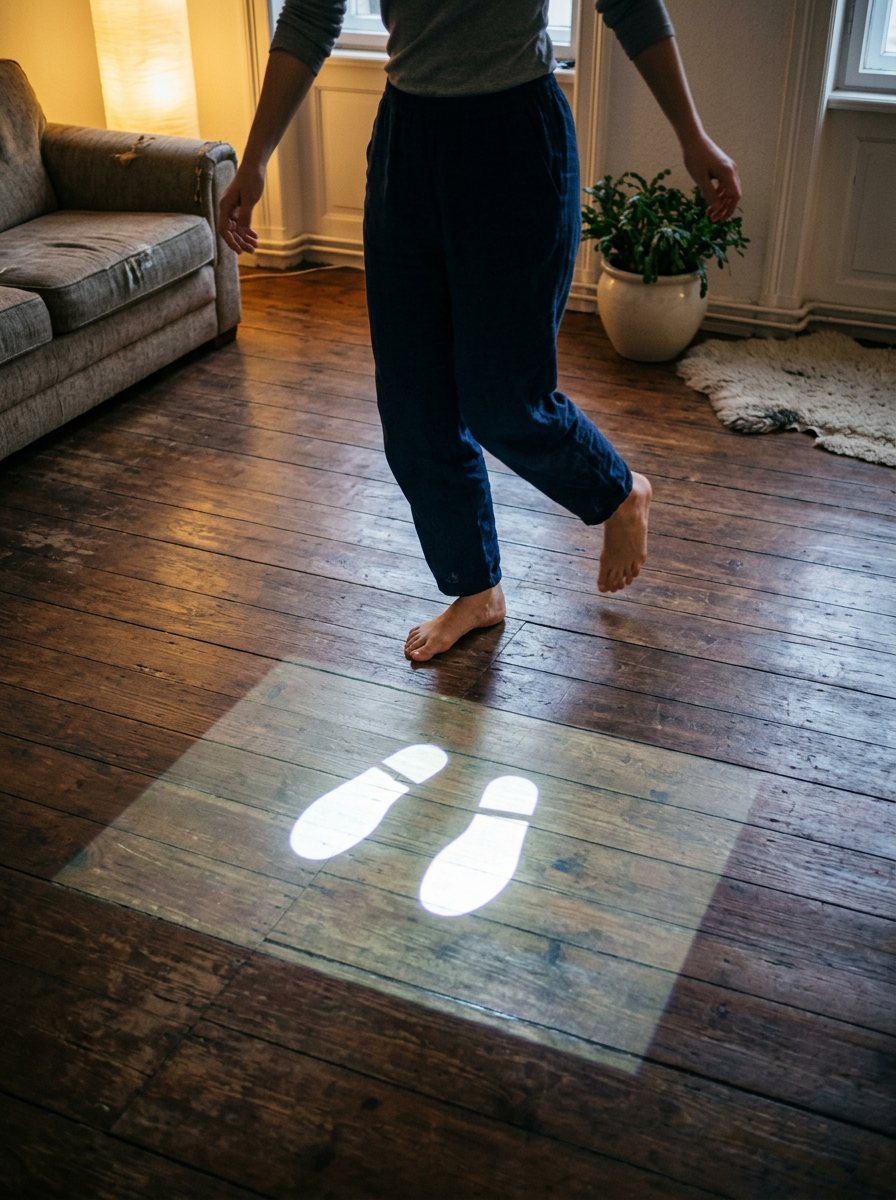
Many people live far from their friends and partners for study or work. Calls keep them talking, but doing something together is hard through an upright screen.
I chose dancing because it is social, it is good for body and mood, and it needs no words. This is my research at Keio University Graduate School of Media Design.
I left out VR and AR on purpose. Headsets can make people feel sick and screens make them tired. The room you already feel safe in becomes the dance floor.
How the concept would look at home: a friend’s footsteps projected on your own floor. AI-generated image, not a photo of the prototype.
Five steps, from a survey at a university exhibition to a tested prototype.
In May 2022 I surveyed 25 visitors at a university exhibition. I asked which sense they would rely on, sight, touch, sound or smell, and where they would want to dance.
Two needs came out of the survey and the reading. People need to see a mark in the room to believe someone is there. And they need privacy: presence without sending video of themselves.
Where I am from, we draw footprints on the ground and treat them as the presence of a god. A bride steps in red ink and leaves red footprints as she enters her new home.
A footprint says that someone is here. So I asked what would happen if a friend’s footprints appeared on my floor.
I also saw that the related work all used an upright surface, a screen or a wall. I chose the floor.
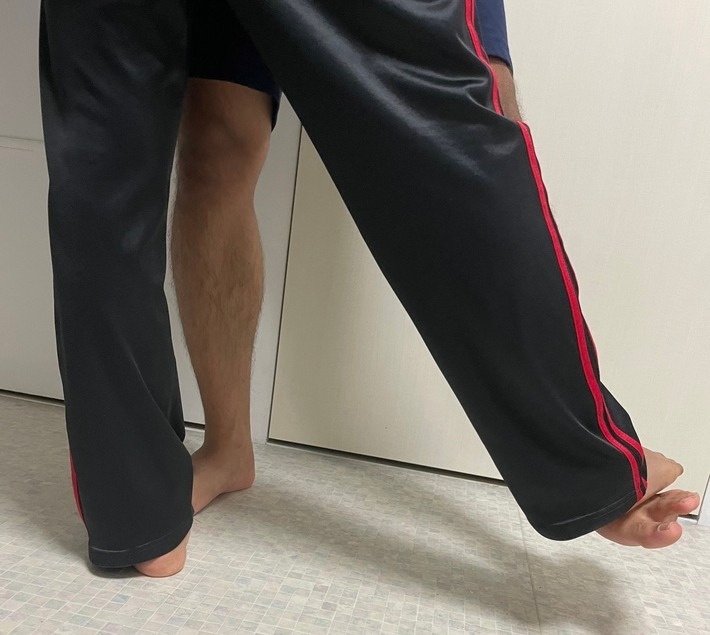

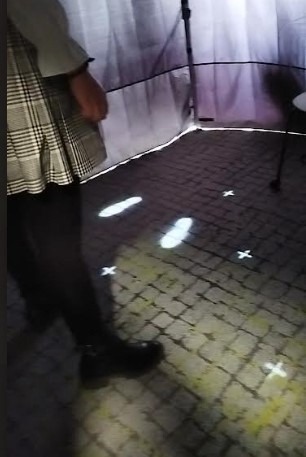
Before building any sensing, I tested the idea by hand. Two white dots were projected on the floor. I moved them with my finger on a phone while I watched the dancer and answered their steps.
35 people tried it. All of them accepted that someone remote was there, because the dots moved in an irregular, imperfect way, like a real person.
They also wanted proof that the dots were their friend, so voice had to be part of the final version. 19 people preferred a footstep shape to an abstract one.
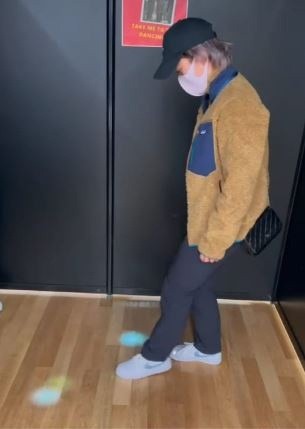
Pre-test at the university forum, November 2022. The two dots on the floor follow my finger on a phone.
A Microsoft Azure Kinect captures each dancer’s ankle and toe positions. TouchDesigner turns that data into two footprints on a rectangular stage and projects them on the partner’s floor.
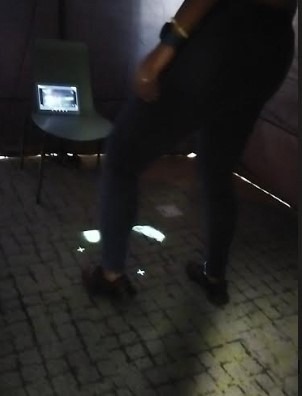
For the test I built two private rooms from two tents in one hall. Each tent had a projector, a speaker, a tablet and a Kinect.
The tents were linked by cable, not the internet, so the footprints had no visible delay.
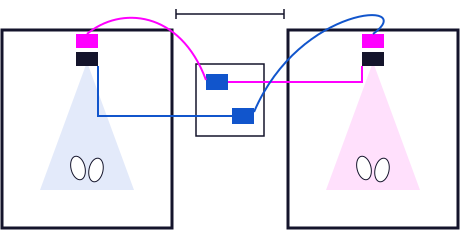
Two tents, 1.8 m apart. The sensor in one tent drives the projector in the other.
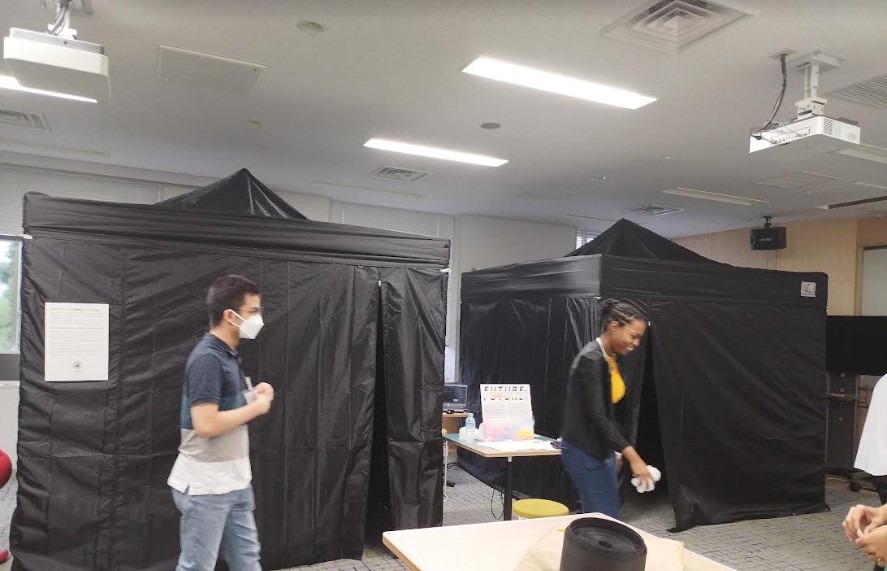
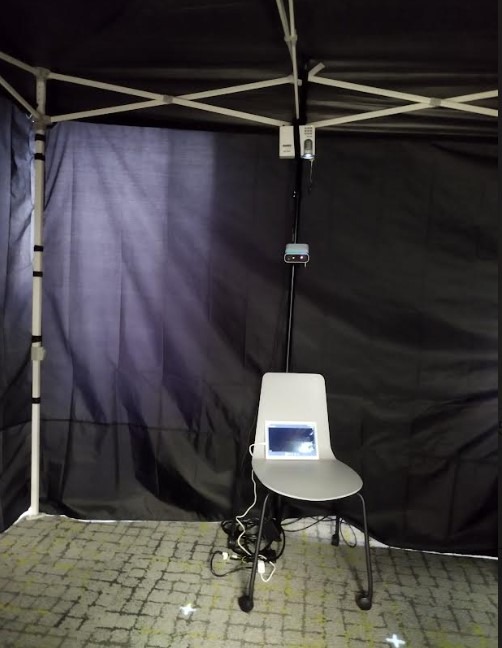
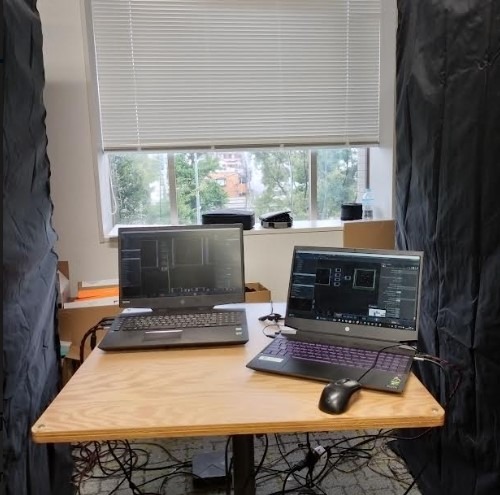
The final user test. Left: the two tents. Middle: inside one tent, with the Kinect and projector on the pole and a tablet on the chair. Right: the two laptops that linked the tents.
14 pairs took part. They were non-dancers aged 20 to 55, plus one four-year-old. Some pairs were friends and some were strangers.
Each pair danced three times. Afterwards I interviewed every participant and they filled in a questionnaire.
What happened
In the interviews, participants said they felt bad about treading on the projected feet, and asked for a bigger stage so they could avoid it. I read this as co-presence: they were treating the footprints as a person.
22 of 28
22 participants were unhappy with the video call within the first 20 seconds.
13 of 18
18 people felt closer once call and footprints ran together. 13 of them said hearing their partner helped. 8 stopped looking at the video and danced with the footprints only.
Strangers
With no camera and no voice they felt more comfortable. Six people preferred dancing with no sound at all.
Each participant scored the three scenarios from 1 to 10. The video call alone averaged 2. The two scenarios with footprints averaged 4 and 8.
“When I am involved in dance, I prefer to move in various directions. I find it limiting to view my partner fixed in one spot.”A participant, about the video call
“I favor the footprint feature without the video since I find dancing in front of a camera somewhat uncomfortable.”A participant in his 20s, paired with a stranger
Non-dancers told me it would be a private way to learn to dance, for people too shy for a class. Couples told me it suits close, wordless communication.